
Clarifying the Order
Freemasonry
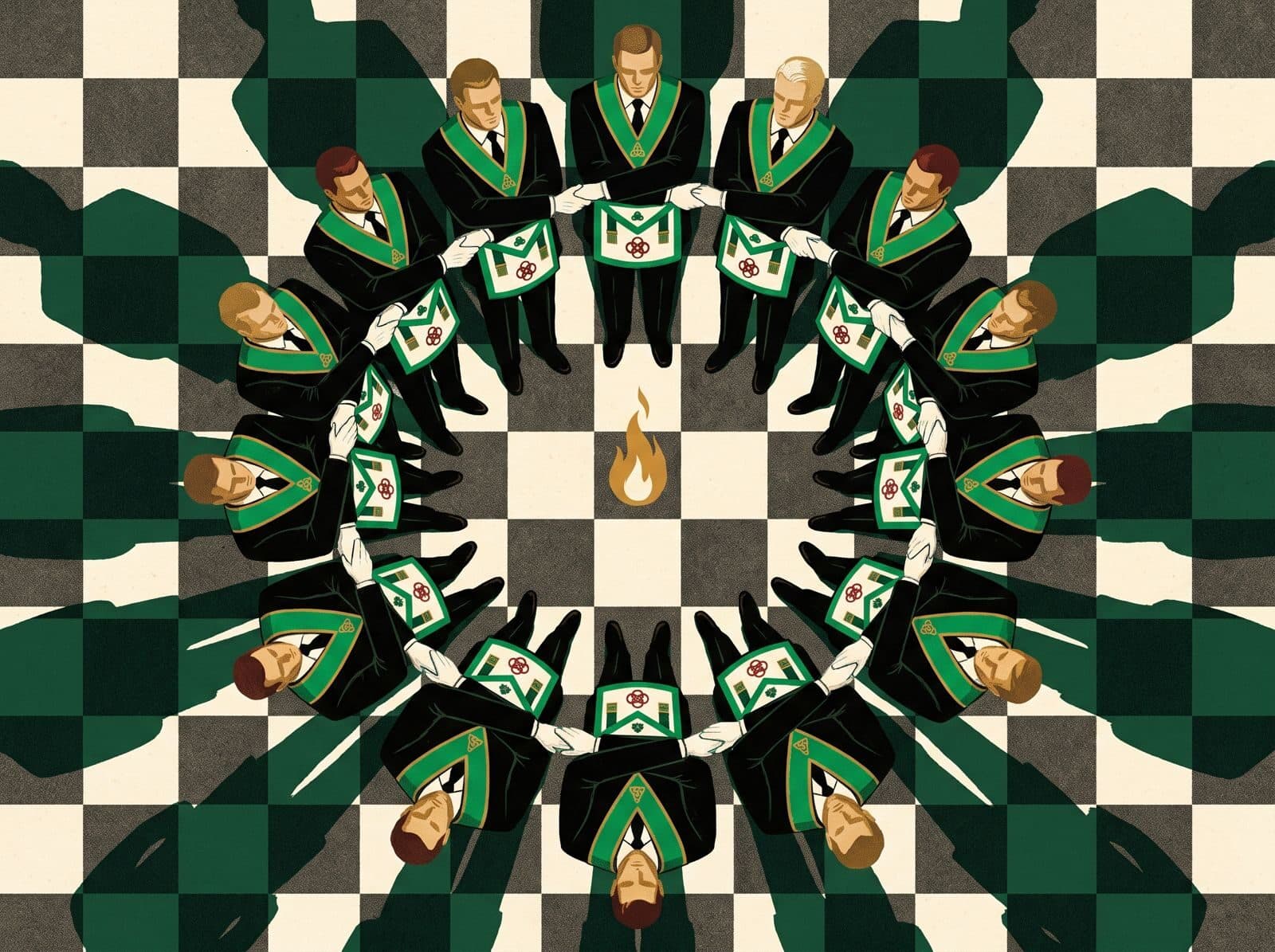
On regularity, recognition and the principles that sustain universal Freemasonry — for those who listen before judging and decide on the basis of truth.
“Sometimes the Square measures the soul. Other times, it measures submission.”
Most Masons confuse, or simply do not know, the true meaning of Regularity and Recognition. These concepts, essential to understanding the legitimacy of Masonic powers and the relations between them, are often reduced to bureaucratic formalities or to inherited prejudice.
Plato's Allegory of the Cave applies here with precision: many live only in the shadow of ideas handed down to them, never seeing the light of truth for themselves. Just as birds born in cages think flying is an illness, some Masons believe the Masonic world is bounded by the walls and definitions they were given — without imagining the vastness and the freedom that exist beyond them.
It is worth shedding some Light on this matter, beginning by clearing up a common misunderstanding: there is no supreme Masonic authority laying down universal law. All Masonic Powers are fully sovereign in their own territory and government. There are, indeed, Obediences that by their antiquity, tradition and standing are widely respected and carry great consultative weight — but they hold no jurisdiction over the others.
A regular Mason must, however, observe fundamental principles that are the basis of universal Freemasonry, such as:
The 12 Rules of Regular Freemasonry
All Regular Masons are bound faithfully to respect and observe the following twelve Masonic rules of Universal Regularity:
- Freemasonry is an initiatic fraternity whose traditional foundation is faith in God, Great Architect of the Universe.
- Freemasonry refers to the “Ancient Charges” and to the “Landmarks” of the Fraternity, in a spirit of absolute respect for the specific traditions of the Masonic Order, which are essential to the regularity of the jurisdiction.
- Freemasonry is an Order to which only free men of good character may belong, who undertake to put an ideal of peace into practice.
- Freemasonry also aims at the moral elevation of the whole of Humanity, through the moral improvement of its members.
- Freemasonry requires of its members the exact and scrupulous practice of the rites and of the symbolism, the means of access to knowledge by the spiritual and initiatic ways proper to it.
- Freemasonry requires all its members to respect the opinions and beliefs of each. It forbids within its bosom any political or religious discussion or controversy. It is a permanent centre of fraternal union, where tolerant and fruitful harmony reigns among men who without it would be strangers to one another.
- Masons take their oaths upon the Volume of the Sacred Law, in order to give them the solemn and sacred character indispensable to their permanence.
- Masons meet, apart from the profane world, in Lodges where the three great lights of the Order are always displayed: the Volume of the Sacred Law, a Square and a pair of Compasses, to work there according to the ritual of the rite, with zeal and assiduity and in accordance with the principles and rules laid down by the Constitution and by the general regulations of the Obedience.
- Masons must admit to their Lodges only men of honour, of full age, of good repute, loyal and discreet, worthy of being good brothers and able to recognise the limits of the domain of man and the infinite power of the Eternal.
- In their Lodges, Masons cultivate love of country, submission to the law and respect for constituted Authority. They regard work as the primary duty of the human being and honour it in all its forms.
- Masons contribute, by the active example of their manly, dignified and wholesome conduct, to the radiance of the Order, in respect of the Masonic secret.
- Masons owe one another fraternal help and protection, even at the end of their lives. They practise the art of preserving in all circumstances the calm and balance indispensable to perfect self-control.
Regularity as Recognition
As Freemasonry grew across the world, the notion of regularity became synonymous with mutual recognition between Masonic powers. That is: “You are regular if you are recognised by a regular power.”
This circular logic has led to disputes about who is truly “regular”, which powers are legitimate, and whether regularity is inherited or built.
The split with Liberal Freemasonry (1877)
In 1877, the Grand Orient of France (GOdF) removed the requirement to believe in a Supreme Being. The United Grand Lodge of England (UGLE) broke off relations with the GOdF, declaring it “irregular”.
Hence the division between Regular Freemasonry (e.g. UGLE, GLNF, etc.) and Liberal or Adogmatic Freemasonry (e.g. GOdF, GLE, mixed and women's Lodges).
Regularity: principle or policy?
Many hold that, over time, regularity ceased to be merely an initiatic principle and also became a political instrument for excluding or legitimising rival powers.
Examples: authentic Lodges, regular in spirit and in practice, are sometimes declared “irregular” for administrative or political reasons. Lodges that follow profound rituals are excluded for want of political recognition. “Sometimes the Square measures the soul. Other times, it measures submission.”
Today: Regularity in transformation
There are today several views of regularity: traditional regularity (the inheritance of the UGLE and of the classical “Landmarks”) and spiritual regularity (fidelity to initiation, to ritual, to inner elevation).
COGMNA (Conference of Grand Masters of North America) – Standards of Recognition
The Standards of Recognition were adopted by the Commission as guidance when it was created, in 1952. These are the criteria used to assess the regularity of a Grand Lodge and thus to determine whether it merits consideration for recognition by the member Grand Lodges. The Commission acts solely in an investigative and advisory capacity.
The Standards of Recognition are summarised as follows:
- Legitimacy of origin (having been formed by 3 Regular Lodges).
- Exclusive territorial jurisdiction, save by mutual consent and/or treaty.
- Adherence to the Ancient Landmarks — specifically: belief in God, the presence of the Volume of the Sacred Law as an indispensable part of the furniture of the Lodge, and the prohibition of the discussion of politics and religion in Lodge.
In Masonic practice, symbols are keys of Light: they open doors to deep understanding, join the visible to the invisible, and allow each Brother to discover, in the silence of his own interpretation, truths that go beyond words.
Freemasonry is not a secret organisation, nor even a discreet one, but a private one — with a purpose. What is discreet tries to go unnoticed; what is private simply reserves certain matters for its members. Freemasonry has a public presence, identifiable buildings and visible action in society. It does, however, keep its internal practices, rituals and symbols private, like any other association with an identity and a tradition of its own. In a world where everything is on the internet, there are only two Masonic secrets: not to reveal who is a Mason, and not to reveal what happens in a ceremony. These ceremonies and their moral lessons encourage us to be more tolerant, more respectful and more diligent in our civic and charitable duties — but they are also moments of joy and fellowship. As the Mason Almada Negreiros said, “joy is the most serious thing in life”.
In Freemasonry there are only two essential secrets. The first is not to reveal who is a Mason, a principle protected by the right to privacy enshrined in the Constitution of the Portuguese Republic, in data protection law and in international conventions. Just as no one is obliged to disclose their religion, political affiliation or convictions, Masonic membership is likewise protected. The second is not to reveal what takes place in a Masonic session, for initiatic, esoteric and spiritual reasons. The ritual experience belongs to the private and sacred sphere, and only acquires meaning for those who live it. The initiatic secret is not told — it reveals itself to a person, in his own time, through mystery.
Freemasonry is clearly distinct from a business club, a club of friends or a charitable club. Its solidarity is deep, regular and anchored in the strength of the egregore and in the inner work of each Brother. Friendship goes beyond fellowship and becomes fraternity, a spiritual bond that unites beyond circumstances. Business may arise, but only as a natural consequence of deepening friendship — never as an aim. What really sets Freemasonry apart is the initiatic way: a path of self-knowledge and inner elevation that gives meaning and grounding to every other dimension.
Today, more than ever, Portugal needs the contribution of its oldest and most respected institutions in order to face collective challenges with vision, courage and service to the common good. Freemasonry, with its tradition of fraternity and philanthropic action, is ready to go on serving — far from prejudice, close to people and faithful to its ideals.
In the 21st century, a Masonic obedience that is not open to civil society does not fulfil its initiatic purpose of sharing the Light it has received. The Organisation need not change in its core values — on the contrary, they matter now more than ever, because the Light we receive is not to be kept, it is to illuminate the world.
Freemasonry is an organisation unlike any other in the world. It has existed for more than 3 centuries, it has no political or religious affiliation, and it counts members of every age, race, cultural standing and profession.
An ancient institution is not an old one. It can keep the values that make it timeless, such as Integrity, which means doing what is right whatever the circumstances; Respect, which is bound up with equality — it does not matter who you are, where you come from, which God you worship, the colour of your skin or your political affiliation: you are respected as an individual, on your merit; and Fraternity, which recognises in the other a brother to be loved, a teaching that moves us to care for those less fortunate than ourselves.
An Obedience that isolates itself from the society in which it lives loses the sense of Initiation. The Light we receive in the Temples is not ours: it is to be shared with the world, because Light that is not shared turns into shadow.
In the 21st century, an Obedience that does not engage actively with the social, cultural and human reality of its time does not fulfil its initiatic role. Tradition, however sacred, is not a museum: it is a living flame that adapts in order to give light to each new generation of seekers of Truth.
Joining Freemasonry makes no one better than anyone else. Freemasonry is a path of personal improvement, in which each Brother works to become the best version of himself — not to rise above others, but to rise within himself. True Masonic progress is measured by humility, by ethics and by the capacity to serve, and not by vanity or comparison.
A Mason must shun Vice and practise Virtue, placing Justice and Truth above all things.
For decades Freemasonry avoided speaking about who we are and what we do, closing the door so tightly that the ordinary citizen does not understand us. That silence allowed ignorance and detractors to fill the void with speculation which, once repeated, turns into supposed fact. This must change. Freemasonry should not merely defend itself; it should explain itself and tell its story — a great story, and a matter of pride. The most important Masonic bodies in the world, such as the English and the American, have already done so successfully. This clarification is not for those who attack out of habit, but for the ordinary citizen who values freedom of thought, listens before judging and decides on the basis of truth.
Yes. Freemasonry is one of the largest and oldest non-religious, non-political, fraternal and philanthropic organisations in the world. It draws on the biblical allegory of the building of Solomon's temple as an image of humanity, to which each Mason contributes as a living stone. It is a universal society whose members cultivate liberty, democracy, equality, fraternity and intellectual, moral and spiritual improvement.
There are six fundamental characteristics: it is an initiatic order (entry through a ceremony of initiation), ritualistic (founded on rites and symbolism), universal and fraternal (it seeks universal fraternity), philosophical (it seeks to answer the deep questions of the human being) and progressive (it works for the progress of humanity). All these principles rest on free thought and tolerance, and aim at the improvement of man, the building of a just and equal society and moral and spiritual progress.
Masons believe in a Great Architect of the Universe, a concept each may interpret according to his own belief. For a Catholic Mason it may be God; for a Muslim Mason, Allah; others may not believe in a revealed entity. What matters is what unites, not what divides. As Pierre Teilhard de Chardin put it: “Religion is not one, there are hundreds of them; spirituality is only one. Religion is for those who sleep; spirituality is for those who are awake… We are not human beings having a spiritual experience… We are spiritual beings having a human experience.”
A Mason must fight vice and practise virtue, placing justice and truth above all things.